
Nerdy About Flooring - Textile Appearance Retention Rating (TARR)
Nerdy About Flooring Series, Episode 2 with Cara Fugate, Philadelphia Commercial
TARR or the Textile Appearance Retention Rating is a testing method in flooring that provides guidelines on how long your carpet will maintain its appearance after traffic. These ratings can be used to gauge if a product will withstand the amount of traffic that your space will encounter on a daily basis.
How is the test performed?
The Hexapod Drum Test is the nationally recognized method that lines the drum of a rotating cylinder with the carpet to be tested. A Hexapod is inserted into the cylinder, which simulates foot traffic on a carpet. The drum is then rotated 12,000 times, which is the same rotation for every carpet tested. After the cylinder has completed its rotations, 3 or more judges evaluate the worn carpet against the original new carpet, using set indicators and give it a final grade of 5-1, 5 meaning no visual change from the control sample and 1 meaning significant change.
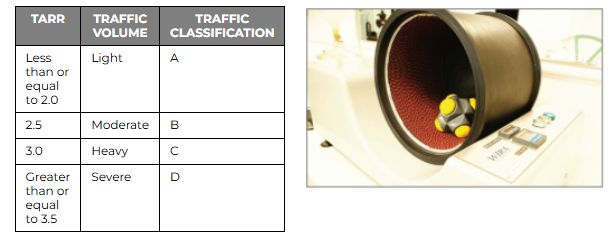
TARR ratings can be used to evaluate how the face of the carpet will wear with light, moderate, heavy, and severe foot traffic. Severe Traffic requires a 3.5 or greater rating and are typically utilized for airports or similar public building. Heavy ratings at 3.0 and higher are typically considered for high traffic office space, corridors, office building public spaces, or similar high traffic areas. The minimum TARR rating for a light commercial space would be a 2.0, which would be for private office space, back of house areas that have minimal staff, or similar spaces that are not open to the public.
If you are working on a budget and have multiple traffic levels, TARR ratings can be used to evaluate products to get the best value for mixed use. Mixing a product with Severe or Heavy rating for entries and common spaces and a more budget friendly Moderate or Light rating for back of house areas that won't need a high traffic wear can be a cost effective way to meet your needs.
Although the TARR rating is a good indicator of how a product will perform in a space, there are other factors that will contribute to the overall performance of a product that are not tested in the TARR method. Those include variations in backings and padding, color of the fibers, maintenance, and other project specific factors. All of these factors should be evaluated when making the final selection for any space.
Resources
PDMS - Texture Appearance Retention Rating (TARR) - Hexapod Information
